
Case Study • UX Research and Product Design
Tangerine Rewards World Elite®* Mastercard®*
Project Overview
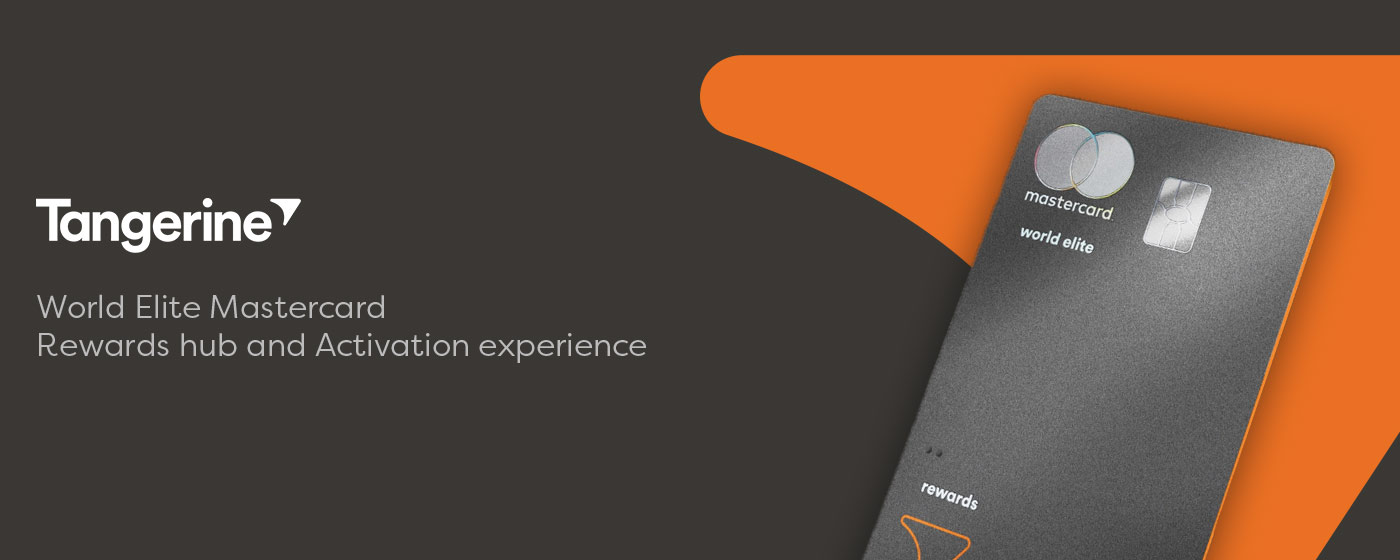
On April 22, 2026, Tangerine released the Tangerine Rewards World Elite®* Mastercard®, their first point based Credit card in partnership with Scene+.
With only Cash back card in their portfolio, there was a gap in the experience for clients, to manage their Scene+ points in their mobile app or the web experience.
Role: Mobile Product designer
I worked on the design of the Native Rewards hub and the activation experience
Within a cross-functional team comprised of Product owner, BA, developers and QAs, I led the End to end Mobile design of the project. We also collaborated with the Web team to deliver a seamless experience across both platforms.
Research and Design Process
1. Design based on assumptions
We created the initial Rewards Hub experience using insights and best practices gathered from other financial institutions and rewards-based credit card programs. These assumptions provided a strong starting point while acknowledging the need for user validation.
2. Validate through user research
In partnership with our Service Designer, I planned and conducted an unmoderated usability study to evaluate the initial designs. The research helped us understand whether the experience aligned with users' expectations and identified opportunities for improvement.
3. Refine the experience
Using insights from the user study, we iterated on the designs to better align with user needs and expectations. The refinements focused on creating a more intuitive, engaging, and valuable rewards experience.
4. Rework the experience
As the project progressed, the business refined the credit card's value proposition. This required us to revisit the Rewards Hub and adapt the experience to reflect the updated product strategy.
We redesigned the Rewards Hub to support the new value proposition by removing features that were no longer relevant and introducing new capabilities.
5. Validate and scale the experience
We conducted a second round of user testing to validate the redesigned experience and ensure the new features were intuitive and easy to understand.
At the same time, I partnered with the desktop design team to help shape the web experience. By sharing research insights and providing visual design direction, we ensured the mobile and desktop experiences remained consistent while adapting appropriately for each platform.
Activation experience
To create a memorable activation experience and reinforce the premium positioning of Tangerine's first annual-fee credit card, we partnered with an external creative agency to design an interactive onboarding experience. The experience was crafted to add a sense of delight while introducing clients to the card's key benefits in an engaging and polished way.
Learnings
User research is invaluable.
Conducting multiple rounds of usability testing gave me a much deeper understanding of how users interact with rewards experiences. Working closely with our Service Designer also strengthened my research skills and reinforced the importance of validating design decisions with real users.
Embrace ambiguity.
The project began with limited requirements, requiring us to design based on informed assumptions. By continuously testing our hypotheses with users, we were able to replace assumptions with evidence and make confident, user-centered design decisions.
Research continues to create value.
As the product strategy evolved, many features were redesigned or reprioritized. However, the research remained relevant throughout the project, providing insights that informed new solutions and accelerated future iterations. Good research is rarely wasted.
Strong partnerships drive better outcomes.
Delivering a cohesive experience required close collaboration across product, engineering, marketing, service design, and external creative agencies. Building strong partnerships and maintaining alignment across teams was essential to creating a consistent and successful end-to-end experience.